

Ask most people what comes to mind when they think of South Korea, and they’ll likely mention K-pop, skincare, cutting-edge technology, or bustling city streets filled with young professionals.
Hun and Eunjoo Sol see those things too.
But after more than a decade serving as International Mission Board missionaries in Seoul, they also see something many visitors never notice.
“Many people think that Korea is exciting and successful,” Hun said. “They think about the K-pop, the K-culture, K-technology, K-cosmetics. Yes, good things… But many Korean people are struggling right now.”

The Sols, who were featured in the 2025 Week of Prayer for International Missions, continue to rely on the prayers of faithful Southern Baptists. Prayers sustain them and help to push back the darkness they confront in their home culture.
Hun often describes that hidden struggle with a Korean word: han. There is no simple English translation. It speaks to a deep sorrow shaped by generations of war, division, loss, and the quiet resolve to endure. Hun sees it in the young adults he meets every week—people navigating loneliness and relentless expectations, quietly asking what their lives are for beneath a veneer of success.
Han is heavy.
For many young adults, that weight can feel unbearable. Suicide is one of the leading causes of death among teenagers and young adults in South Korean. Hun and Eunjoo see the effects of that reality every day, and it’s one reason they believe they have no time to waste.
That understanding shaped the week of Serve Tour Seoul this summer.
There were no construction sites, no paintbrushes, no tools or work gloves. Instead, the team stepped into ministries local churches had been faithfully building long before the volunteers arrived. In May, 27 volunteers from seven churches across the United States came alongside local churches already serving their communities in Seoul, Paju, and Gwangju. They taught English classes, ran children’s camps, walked neighborhoods in prayer, distributed food, and sat down with college students, one conversation at a time.
For Nick Holst of Sandals Church in Riverside, California, the goal was simple enough to say in a sentence:
“We came to meet people,” Holst said. “We want to hear their stories, and that leads to some very meaningful connections as you get past the surface into something deeper.”
That’s where the week actually lived: past the surface and past the small talk, where the quiet weight of han is often carried without words.
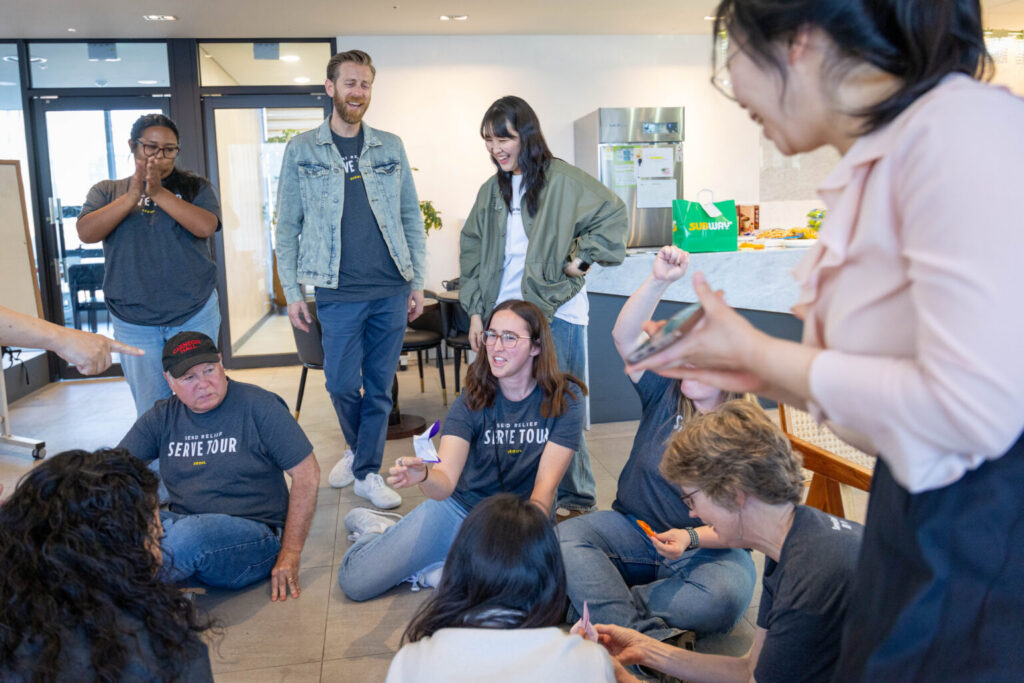
On college campuses, volunteers played games, asked questions and mostly just listened. Some conversations lasted a few minutes and ended there. Others kept going long past the point where either person expected them to.
One morning, after asking his church back home to pray, Holst sat down with a university student named Intec. They talked about culture first, the way strangers do, and then the conversation turned somewhere neither of them planned.
“I got to ask him, ‘What do Koreans believe?’” Holst recalled.
Intec said he didn’t believe in God. Then he recited John 3:16 from memory, word for word, a verse he’d heard somewhere along the way and never forgotten. Before they parted, Holst asked if he could pray that God would keep drawing Intec toward Himself.
“He said yes.”
In a city where many conversations never move beyond the surface, the exchange was a reminder of why the team had come. Not to win an argument, but to listen, to ask questions, and to trust God with what happens next.
The same pattern unfolded elsewhere, beginning in classrooms and ending on city streets.
Jeremy Doyle, missions pastor at Valley Baptist Church in Bakersfield, California, watched an English conversation club grow from two students on its first night to eight by the second. Nobody advertised it as anything more than a place to practice English, but the room kept filling, and so did the conversations.
The team’s work with students didn’t stop there. At a nearby Christian school, volunteers led an English camp, teaching vocabulary alongside Bible stories and sharing their own testimonies. In one classroom, Doyle stood at a whiteboard walking students through 3 Circles, a simple evangelistic explanation of God’s design, brokenness, and the hope found in Jesus Christ.
Each afternoon, some of the older students joined the volunteers in the city, putting into practice what they had been learning by starting conversations with strangers and sharing their faith.
One of those afternoons, Doyle and fellow volunteer Jay Ransom struck up a conversation with a group of young men. Before long, Ransom, in his 60s, challenged one of them to a push-up contest right there on the sidewalk.
The young men laughed, cheered on their friend, and pulled out their phones to record. By the time it was over, social media handles had been exchanged, and the men hugged goodbye—remarkable for people who had been strangers just 30 minutes earlier.

By the end of the week, some of the Korean students who had first come simply to practice their English were the ones stepping out to share their own faith with others.
For Nick Kim, pastor of Uptown Baptist Church in Chicago, the trip carried a personal weight before it ever began.
His team partnered with TOV Church throughout the week, helping launch the church’s first Vacation Bible School, praying for Yonsei University, and encouraging local believers. Later, they traveled to the Korean Demilitarized Zone (DMZ), where they joined Pastor Jun Yu in praying for North and South Korea.
For Kim, the prayer was deeply personal. His father was born in North Korea. Kim was born in South Korea. Standing just miles from the border, Kim said that praying “felt less like an abstract request and more like my own family’s story.”
“We love to partner with churches that we do ministry within different parts of the world,” Kim said. “We don’t see it as first time and last time. We continue that relationship.”
That’s the same long game Hun and his wife, Eunjoo, have been playing for years. With 48 universities across Seoul, they’re helping local churches reach college students through church plants, English conversation groups, trauma healing training, and Bible-based ministries, spaces where people can finally say the hard thing out loud and hear there is hope and healing in Christ. Their prayer is bold: to see a church planted on every one of Seoul’s 48 university campuses by the end of 2028.
In a country the world associates with achievement, the deepest need in the room is rarely the one on display. Sometimes it just takes someone willing to stay in a conversation past the point where it would’ve been easier to leave.
That’s what 27 volunteers did for 10 days in May.
Months later, those churches in Seoul, Paju, and Gwangju are still building relationships and creating space for people to bring their deepest hurts into the light.
For many, those hurts have a name: han.
The hope that heals them has a name, too: Jesus Christ.