

The chapel at Council Road Baptist Church in Oklahoma City turned into a science lab on Oct. 5-6. Microscopes, beakers and test tubes weren’t in the room, but this Sending Church Lab drew nearly 40 people representing 12 Oklahoma Baptist churches committed to send and care for international missionaries well.
The Sending Church Lab, facilitated by the International Mission Board, brought pastors, church leaders and missionaries together for two days of discussion, self-assessment and planning centered on one question: What does it mean for a church to truly be a sending church?

Staff members at First Baptist Church in Wagoner, Oklahoma, evaluate their church’s involvement with missions and missionary support. IMB Photo
For Mike Wall, a global missions ministry partner of Oklahoma Baptists, the answer begins with churches reclaiming responsibility for the Great Commission.
Wall first attended a Sending Church Lab last year in Tulsa with few expectations. He left convinced more churches needed the training.
“When I went there, I thought, ‘You’ve got to do this in Oklahoma City,’” Wall said, “because of the content and how much our churches need something just like this.”
After observing churches work through the exercises in the lab, Wall said he was encouraged by an emphasis on local church ownership in missions.
“We can’t just send our people and say, ‘OK, now this is your job, IMB,’” he said. “We have to do our job in sending, preparing and training the best ‘sent ones’ so that when they get to the field, they can already hit the ground running.”
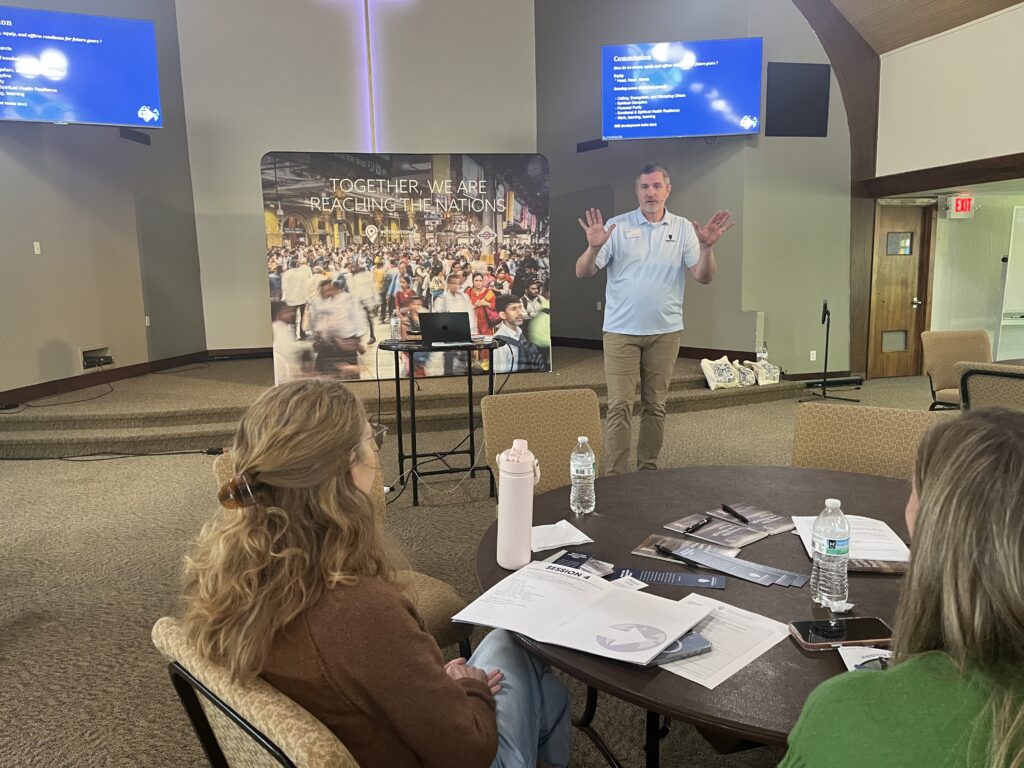
Bryan Wooten, IMB senior church engagement specialist, leads a Sending Church Lab at Council Road Baptist Church in Oklahoma City. He is emphasizing the importance of sending churches assessing and equipping future IMB missionaries. IMB Photo
Leading the lab was Bryan Wooten, IMB senior church engagement strategist, who developed the concept after seeing the need for stronger relationships between missionaries and local churches.
“A Sending Church Lab is our attempt to raise up a host of IMB sending churches,” Wooten said, crediting the North American Mission Board for doing similar events and having successful results.
The lab helps churches understand what Wooten calls the church engagement pathway: praying, cooperating, partnering and sending. While many churches faithfully pray, give and go, he said sending requires something more intentional.
“Sending includes taking responsibility for an IMB missionary by providing ongoing encouragement, accountability and soul care throughout their term of service,” he explained.
During the two-day event, participants gathered around whiteboards to evaluate their church’s missions practices, identify strengths and weaknesses and develop plans for improvement.
“We don’t just need to deliver content,” Wooten said. “We need to invite churches to do some work on their own.”
Rather than simply listening to presentations, attendees worked through practical questions about prayer, giving, short-term missions, missionary assessment and long-term care. Wooten said churches consistently tell him the greatest benefit is clarity.
“They are thankful for clarity on what an IMB sending church is and what our roles and responsibilities are,” he said.
For IMB missionaries Peter and Katie Weeks, that clarity is especially valuable. They participated in the lab alongside church leaders. Their real names have been changed to protect their work in Southeast Asia.
“There’s no other place I’d rather be during these few days than here,” Peter said.
Katie appreciated the interactive nature of the training.
“I really appreciate the way they’re actually requiring information from the different churches and encouraging dialogue about how they can go through the steps,” she said.
From a missionary perspective, she believes the lab addresses a common challenge.
“It’s hard to know sometimes as churches how to be a good sending church and how to support missionaries,” she said. “Sometimes it’s really difficult for missionaries to ask for help.”
Church leaders attending the lab echoed those sentiments.
Mark Roby, a deacon at First Baptist Church in Midwest City, said the training is helping churches recognize their responsibility in global missions.
“I don’t think people recognize they are the sending church,” Roby said. “It’s more like they think IMB does it. I think that needs to be awakened in the churches.”
Rusty Leonard, an elder at Crosstown Church in Oklahoma City, chose to attend after church leaders discussed challenges in caring for missionaries long-term. The invitation via email arrived in his inbox the morning after one such conversation.
“I thought, ‘How timely!’” Leonard said. “One of those ‘God coincidences.’”
The lab has already given him plenty to consider.
“We’ve been challenged to think about our role as a church maybe differently than what we have,” he said.
As Sending Church Labs continue expanding across the country, Wooten believes they offer a strategic opportunity to strengthen missionary support and help churches take greater ownership of sending and caring for missionaries.
In the past two years, Sending Church Labs have been hosted in New Mexico, Texas and Colorado. Wooten mentioned there are prospects to have these labs in seminaries, as one was held at Southwestern Baptist Theological Seminary in Fort Worth.
“The big vision is we want to raise up IMB sending churches and really call the church to be the church,” Wooten said.
Planning for additional Sending Church Labs in 2027 has already begun. Those interested in hosting a lab may contact Wooten at bwooten@imb.org.
Names changed for security.